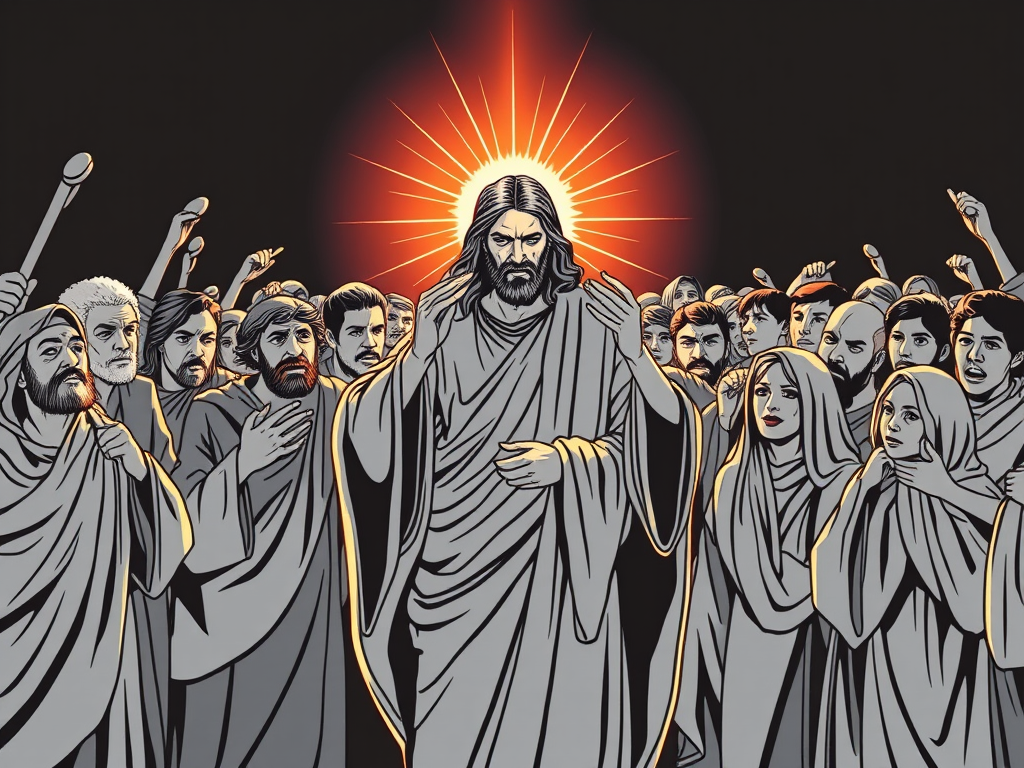
Pericope Adulterae refers to John 7:53–8:11, the story about the woman accused of adultery taken before Jesus to test him.
The debate is whether or not this story was originally in the Gospel of John and if not, whether the story is actually true.
EVIDENCE AND HISTORICAL WITNESS
3rd Century and Earlier:
The pericope is not in the Greek Gospel manuscripts from Egypt. The Pericope Adulterae is not in papyrus 𝔓66 or in papyrus 𝔓75, both of which have been assigned to the late 100s or early 200s, nor in two important manuscripts produced in the early or mid 300s, Sinaiticus and Vaticanus. It is absent in the earliest and closest writings to the actual events.
Protoevangelium of James
Now there is the Protoevangelium of James, written around 150 to 200 AD. It is a apocrypha writing not recognized as authoritative or accepted even by the disciples of the disciples of the Apostles. Origen was aware of this document and doubted it as well. Origen made critical marks and indicated that this story was interpolated or added later and was not part of the original gospel. And this was fairly early, around 230 AD. The earliest manuscript of the text (Papyrus Bodmer 5) dates to the third or fourth century.
The author of the document claimed to be James the brother of Jesus by an earlier marriage of Joseph and taught the perpetual virginity of Jesus. This teaching and writing was condemned by Pope Innocent I in 405AD and classified as apocryphal by the Gelasian Decree around AD 500AD. Due to contradictory teachings from the other synoptic gospels and other known scripture, and that it misunderstands and/or misrepresents many Jewish practices, it is easily discredited as divinely authoritative and inspired.
Its origin is probably Syrian, and it possibly derives from a sect called the Encratites, whose founder, Tatian, taught that sex and marriage were symptoms of original sin. Which explains the invented idea of Mary’s perpetual virginity. Thus we can conclude that this is not a creditable witness to the Pericope Adulterae
(Side note: its worrisome that the Catholic Church embraced a doctrine that is only sourced from an non-inspired, non-divinely authoritative apocrypha writing, condemned by the Catholic Church via Pope and Decree, and still transformed it into an essential Mariology dogma of their entire church.)
According to Eusebius of Caesarea (in his Ecclesiastical History, composed in the early 300s), Papias (c. AD 110) refers to a story of Jesus and a woman “accused of many sins” as being found in the Gospel of the Hebrews, but, the woman at the well was accused of having 5 husbands, so he could have been referring to this. Thus, this statement by Eusebius about Papias is of no support for the pericope. Thus we can conclude that this too is not a creditable witness to the Pericope Adulterae
According to Agapius of Hierapolis (930AD), Papias wrote a treatise on the Gospel of John, a copy of which we do no longer have, where he included the story within the Gospel itself. But, this is not verifiable and given the track records of ancient document name associations and all the pseudo-authorships, this cannot be taken as useful or reliable on face value. Not to mention this is from a writer in the 10th century. Also, he could have been just referencing what Eusebius said about Papias. Thus we can conclude that this too is not a creditable witness to the Pericope Adulterae.
In the Syriac Didascalia Apostolorum, composed in the mid-200s, the author, in the course of instructing bishops to exercise a measure of clemency, states that a bishop who does not receive a repentant person would be doing wrong – “for you do not obey our Savior and our God, to do as He also did with her that had sinned, whom the elders set before Him, and leaving the judgment in His hands, departed. But He, the searcher of hearts, asked her and said to her, ‘Have the elders condemned thee, my daughter?’ She said to Him, ‘No, Lord.’ And He said unto her, ‘Go your way; neither do I condemn thee.’ In Him therefore, our Savior and King and God, be your pattern, O bishops.” Now, this is a decent reference to the story. This is also echoed in The Constitutions of the Holy Apostles written around 380 AD.
Finally, we have 1 decent witness in the 3rd century, around 250 years after Jesus.
4th and 5th Century
Didymus the Blind states around 360AD that “We find in certain gospels” an episode in which a woman was accused of a sin, and was about to be stoned, but Jesus intervened “and said to those who were about to cast stones, ‘He who has not sinned, let him take a stone and throw it. If anyone is conscious in himself not to have sinned, let him take a stone and smite her.’ And no one dared,” This too is a fairly decent reference to the story, but one can argue that the “certain gospels” he is talking about may very well be the discredited Protoevangelium of James; but, regardless, this summery of the story fits what we understand the story to say.
This gives us a 2nd decent witness within 330 years after Jesus.
Pacian of Barcelona, who was bishop from 365AD to 391AD, stated: “O Novatians, why do you delay to ask an eye for an eye? […] Kill the thief. Stone the petulant. Choose not to read in the Gospel that the Lord spared even the adulteress who confessed, when none had condemned her.“
This gives us a 3rd decent witness within 330 years after Jesus.
The first surviving Greek manuscript to contain the pericope is the Latin-Greek diglot Codex Bezae, produced in the 400s or 500s AD. This 5th century Codex Bezae is also the earliest surviving Latin manuscript to contain it. Out of 23 Old Latin manuscripts of John 7–8, seventeen contain at least part of the pericope.
Jerome, writing around 417AD, reports that the Pericope Adulterae was found in its usual place in “many Greek and Latin manuscripts” in Rome and the Latin West.
It was quoted or paraphrased by multiple Latin speaking early Christians, and appears within their quotations of the New Testament often. It is quoted by later church fathers such as Hilary of Poitiers (350AD), Gregory the Great (590AD), Leo the Great (450AD), Ambrose (380AD), and Augustine (420AD). However, if you notice, the earlier church fathers do not quoted it such as Tertullian (200AD) or Cyprian (230AD), which might imply that it was missing from their manuscripts OR the story didn’t fully evolve yet. The story is present in the vast majority of pre Vulgate Vetus Latina manuscripts, but these were full of errors and variants. It is in all except one primary manuscript of the Latin Vulgate (382 AD).
6th Century until now
Codex Sangallensis 48, a Greek-Latin manuscript of the 9th century, even leaves blank where that story traditionally fit.
During the 16th century, scholars from Western Europe—encompassing both Catholic and Protestant traditions—endeavored to recover the most accurate Greek text of the New Testament, rather than depend on the Vulgate Latin translation. During this period, it was observed that several early manuscripts encompassing the Gospel of John omitted John 7:53–8:11 in its entirety; furthermore, certain manuscripts that included these verses annotated them with critical symbols, typically a lemniscus or an asterisk, which usually indicate interpolation. Additionally, it was noted that, within the lectionary of the Greek church, the Gospel reading designated for Pentecost extends from John 7:37 to 8:12, thereby bypassing the twelve verses of this pericope.
Both the Novum Testamentum Graece (NA28) and the United Bible Societies (UBS4) provide critical text for the pericope, but mark this off with double square brackets, indicating that the Pericope Adulterae is regarded as a later addition to the text.
Out right exclude/ignore/don’t know about it:
Clement of Alexandria (died 215), Tertullian (died 220), Origen (died 254), Cyprian (died 258), John Chrysostom (died 407), Nonnus (died 431), Cyril of Alexandria (died 444), Cosmas (died 550) and later Christians such as Vardan Araveltsi (13th century) all exclude the Pericope Adulterae.
Question the stories authenticity:
Codex Vaticanus 354, Codex Basilensis (E) includes 8:2ff; Codex Tischendorfianus III (Λ) and Petropolitanus (П), Codex Basilensis A. N. III. 12 (E) (8th century), Euthymius Zigabenus (12th century) all have made notations that question it’s authenticity in the gospel of John.
Modern Scholarship
J. B. Lightfoot wrote that absence of the passage from the earliest manuscripts, combined with the occurrence of stylistic characteristics atypical of John, together implied that the passage was an interpolation. Bart D. Ehrman concurs in Misquoting Jesus, adding that the passage contains many words and phrases otherwise alien to John’s writing. Daniel B. Wallace agrees with Ehrman
Michael W. Holmes says that it is not certain “that Papias knew the story in precisely this [short] form (not entirely true), inasmuch as it now appears that at least two independent stories about Jesus and a sinful woman circulated among Christians in the first two centuries of the church (not entirely true), so that the traditional form found in many New Testament manuscripts may well represent a conflation of two independent shorter, earlier versions of the incident.” Kyle R. Hughes has argued that one of these earlier versions is in fact very similar in style, form, and content to the Lukan special material (the so-called “L” source), suggesting that the core of this tradition is in fact rooted in very early Christian (though not Johannine) memory.
Theories as why it was not in early manuscripts:
Augustine’s theory that some men had removed the passage due to a concern that it would be used by their wives as a pretext to commit adultery.
Burgon proposed a theory that the passage had been lost due to a misunderstanding of a feature in the lection-system of the early church.
In September 2020, the Chinese textbook《职业道德与法律》(Professional Ethics and Law) was alleged to inaccurately recount the story with a changed narrative in which Jesus stones the woman, while stating “I too am a sinner. But if the law could only be executed by men without blemish, the law would be dead.” Now millions of these textbooks have been printed. Thus, 1,000 years from now, they will discover manuscripts of this book, and continue the evolution of this story.
We think John the Apostle gives us the best and divine explanation:
John 20:30-31
30 Jesus performed many other signs in the presence of his disciples, which are not recorded in this book. 31 But these are written that you may believe that Jesus is the Messiah, the Son of God, and that by believing you may have life in his name.
A fragment of Papias also records a separate sort of miracle not in the synoptic gospels. Thus, these could all be the stories of the things Jesus actually did, but were not written in the gospels, but were oral traditions.
Whether the Pericope Adulterae was removed or never added leads us to the next most important question: should WE add it to scripture, even if it may be a true story of Jesus?
Without the story, knowing Jesus is not lost and believing in Jesus as the Messiah, the Son of God and have eternal life is possible, John said so. So, is it necessary to include it?
It may highlight a sort of character and nature of Jesus in how he deals with the sinner and those who think they are better than sinners. But should we teach it, the story, as though it is the divine authority of God, even though it may not be?
This doesn’t take away from the reliability, sufficiently, or authority of the Bible. It proves the deepest extent that these documents and stories are analyzed through history. With the story added, being that it may be an actual thing Jesus did that was told through oral tradition or it is a story of Jesus that evolved over time, it has not negative impact whatsoever on the doctrines of Holy Scripture or on the revealed person, character, and nature of Jesus Christ.


Leave a Reply to Examining the Reliability and Historical Context of the BibleCancel reply